
Britain at War, a lot (short history primer)
- Nov 21, 2021
- 3 min read
"Reflecting on the past, while living in the present, gives us future insight".
Wendy Arraki
The era of Jane Austen's life corresponds with a very transformative time in British history and Britain at war, a lot. From war in America to the beginning of the industrialization period as well as a flourishing interest in the arts and sciences by mad King George III*, Austen imbibes her writings with hints of these events without directly addressing them. She chose to write about what she knew.
I love the different name descriptors for the same event or location. What Americans call the Revolutionary War the British call the American War for Independence. France proclaimed war on Great Britain following the French Revolution, and again under Napoleon's rule during the Napoleonic Wars. Fearful of Napoleon's dominance on the world stage and the possibility of an attack on English soil, Britain continued fighting until the Battle of Waterloo (French call it the Battaile de Mont-Saint-Jean) and Napoleon's defeat, all in Jane's era.

War costs money and with England's need to replenish their war chests, a new form of revenue was enacted by taxing the colonies. The Stamp Act that imposed a tax on all paper documents was the first internal tax. It was a tax that raised money to finance the British soldiers in America. That must have stung.
Of course they were upset and it gave Patrick Henry a chance to make his famous quote, "give me liberty or give me death". Subsequent taxes followed and the pesky, independent colonists, tired of the taxation to support a war against them and in Europe, that didn't affect their lives, started to chafe at English rule.
In Austen's novels, outside of the genteel lifestyles represented, 1/3 of the country's population lived on the verge of starvation causing food riots and extreme debt from wartime expenses.
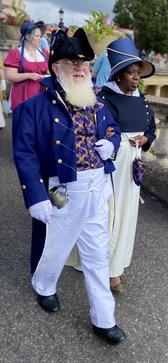
When the 10 day Jane Austen event came to settle and infiltrate the streets of Bath, soldiers were well represented. 2 of Jane's brothers were soldiers. Perhaps a few Wickhams from Pride and Prejudice were present.


Wounded soldiers possibly fighting France over the rights to the English Channel. What the British call the English Channel, the French call La Manche. Seems as though not much has changed with the present escalation of fishing rights between UK and France.


Highway men made their disguised appearance at the festival. They have been romanticized in literature but presented real danger on road travel during Austen's lifetime.

Children took their roles (poses) very seriously.


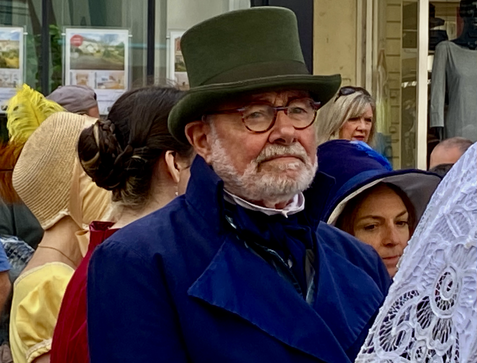
Men in Hats.




Parasols guarding the exquisite creamy Regency complexion.

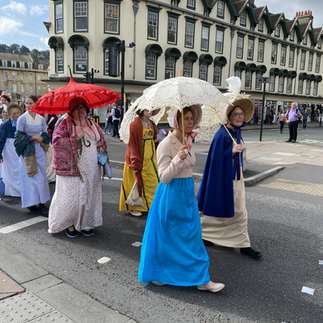

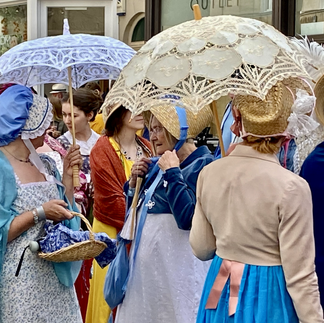


This lovely lady who works in movie production in London came to participate having made all her outfits, even redesigning her shoes so a ribbon was delicately used as a closure.


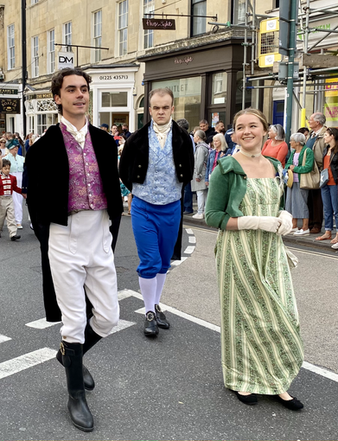

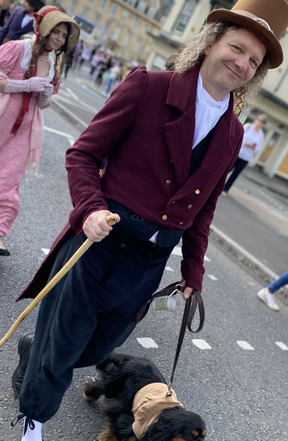
What could we do but join in the fun, a tour, a dance lesson and live theater with the characters from an unpublished Austen novel, Austen Undone! It had all the usual Austen personalities, devoted daughter, rich Uncle who supports members of the family, wealthy bachelor, pious preacher, pushy mother, independent thinking women.

The majority of the unsuspecting participants knew the first line of Pride and Prejudice by heart. Do you? We did not.
'It is a truth universally acknowledged, that a single man in possession of a good fortune, must be in want of a wife'.

Then we went to dance lessons. I had some success learning a Sir Roger de Coverely dance.


I especially liked the dancing clips
Beautiful costumes!! Where was your dress?
What a wonderful celebration and event to be part of.
I searched the crowds but could find neither of you in costume.
Thanks for the history lesson. Karen
But did the two of you dress up for the occasion? And if yes, where are the photos?!
Happy to see you immersing yourselves in English culture!